

Issue #6
Your Onboarding Process is Your DevEx Canary in the Coal Mine ⚠️
Last week, we dove deep into the documentation drama (and yes, some of you sent me screenshots of your team's "Ask Jason" moments – I feel your pain).

Welcome back, developrrrs! 👋 Last week, we dove deep into the documentation drama (and yes, some of you sent me screenshots of your team’s “Ask Jason” moments – I feel your pain).
This week, we’re tackling something equally crucial: developer onboarding. Because let’s face it, your first week at a new job shouldn’t feel like being dropped into the Hunger Games with nothing but a login credential and a vague notion of where git lives.
Consider this your onboarding optimization guide – because every developer deserves better than searching Stack Overflow for “where is config file help plz.”
🤿 Deep Dive
Here’s a truth bomb: your onboarding process is a mirror reflecting your entire development ecosystem. If your onboarding is a mess, I’ve got bad news about the rest of your processes. Here’s a stat to make you rethink your onboarding: 20% of employee turnover happens within the first 45 days. That’s like losing a player during pre-season! Yet somehow, most engineering teams treat onboarding like that one container in your fridge – you know it needs attention, but you keep pushing it back until it becomes a science experiment.
⚠️ The Warning Signs
When I see a team struggling with onboarding, it’s usually a symptom of deeper DevEx issues:
1. Manual Environment Setup
If your setup instructions include phrases like “ping Sarah for access” or “ask the DevOps team to whitelist your IP,” you’re not just failing at onboarding – you’re showcasing broken access management. The DORA State of DevOps Report shows that high-performing teams automate up to 95% of their configuration management. Manual setup isn’t just inefficient; it’s a red flag waving frantically at your automation gaps.
2. Outdated or Missing Documentation
When your onboarding doc still references tools you deprecated last year, it’s not just poor documentation – it’s a sign that knowledge sharing isn’t part of your culture. According to GitHub’s Open Source Survey, 93% of developers say incomplete documentation is a pervasive problem. If you can’t keep onboarding docs current, what does that say about your API documentation or architecture decisions?
3. The “Figure It Out” Approach
If your onboarding strategy is essentially “Here’s your laptop, good luck,” you’re probably taking the same approach to production incidents, technical debt, and feature development. That’s not agility; that’s chaos wearing an agile costume.
🚀 Building an Onboarding Process That Doesn’t Suck
Great onboarding isn’t just about getting people productive – it’s about demonstrating your engineering culture in action. Here’s what excellence looks like:
Automated Environment Setup
-
One-command development environment setup using tools like DevContainers that takes minutes, not days
-
Automated access provisioning with clear audit trails – no more “waiting for admin approval” limbo
-
Standardized tooling that mirrors production environments to minimize the “works on my machine” syndrome
-
Infrastructure as code for consistent environments across the team
-
Self-service tools that empower developers to solve common issues without playing the waiting game
Structured Learning Path
-
Clear milestones for the first 30/60/90 days with specific, achievable goals
-
Progressive complexity in assigned tasks, starting with documentation updates and moving to feature work
-
Dedicated time for codebase exploration – because understanding the “why” is as important as the “how”
-
Regular checkpoints with meaningful feedback that goes beyond “looking good!”
-
Pair programming sessions with experienced team members who can share context and tribal knowledge
Knowledge Transfer That Works
-
Living documentation that’s part of your CI/CD pipeline – if the code changes, docs must change
-
Architecture decision records (ADRs) that explain not just what but why certain choices were made
-
Clear ownership and escalation paths so new developers know exactly who to ask for what
-
Searchable knowledge base integrated with your development tools
-
“Office hours” with senior team members for deeper technical discussions
📈 The Success Metrics
How do you know if your onboarding is working? Track these metrics:
-
Time to first commit (day one)
-
Time to first feature deployment (aim for week one)
-
Number of access-related blockers (should be zero)
-
Documentation update frequency (should match your deployment frequency)
-
Number of questions asked repeatedly (indicates documentation gaps)
-
New hire confidence ratings at 30/60/90 days
🎯 Real Impact
The best teams I’ve worked with treat onboarding like a product feature. They iterate on it, measure its success, and constantly improve it. One team reduced their onboarding time from three weeks to three days by implementing an automated environment setup and clear documentation standards. Another saw their new developer retention rate jump from 65% to 92% in six months after revamping their onboarding process.
And here’s the kicker – teams with great onboarding processes typically perform better across all DevEx metrics. According to the State of DevOps Report, these teams deploy code 208 times more frequently and have change failure rates 7 times lower than their peers.
The Bottom Line
Your onboarding process isn’t just about getting new developers up to speed – it’s a litmus test for your entire developer experience. If a new developer can’t get their environment set up easily, how can you expect them to deploy confidently to production? If your onboarding docs are outdated, what does that say about your API documentation?
Every friction point in your onboarding process is probably mirrored somewhere in your daily development workflow. Fix it here, and the benefits will ripple throughout your development lifecycle.
Let’s be honest: that first impression of your onboarding process sets the tone for everything that follows. Make it good, and you’ll build loyalty. Make it great, and you’ll build advocates.
Next week, we’ll dive into the role of automation in DevEx. Until then, remember: if your onboarding process requires a prayer circle and has more prerequisites than a computer science degree, you might be doing it wrong.
Ship fast (and onboard faster ⚡️)!
Powered by caffeine ☕ and the memories of every developer who spent their first week just trying to run ‘npm install’
📊 Stat
52% of developers cited burnout as a reason their developer peers leave their job
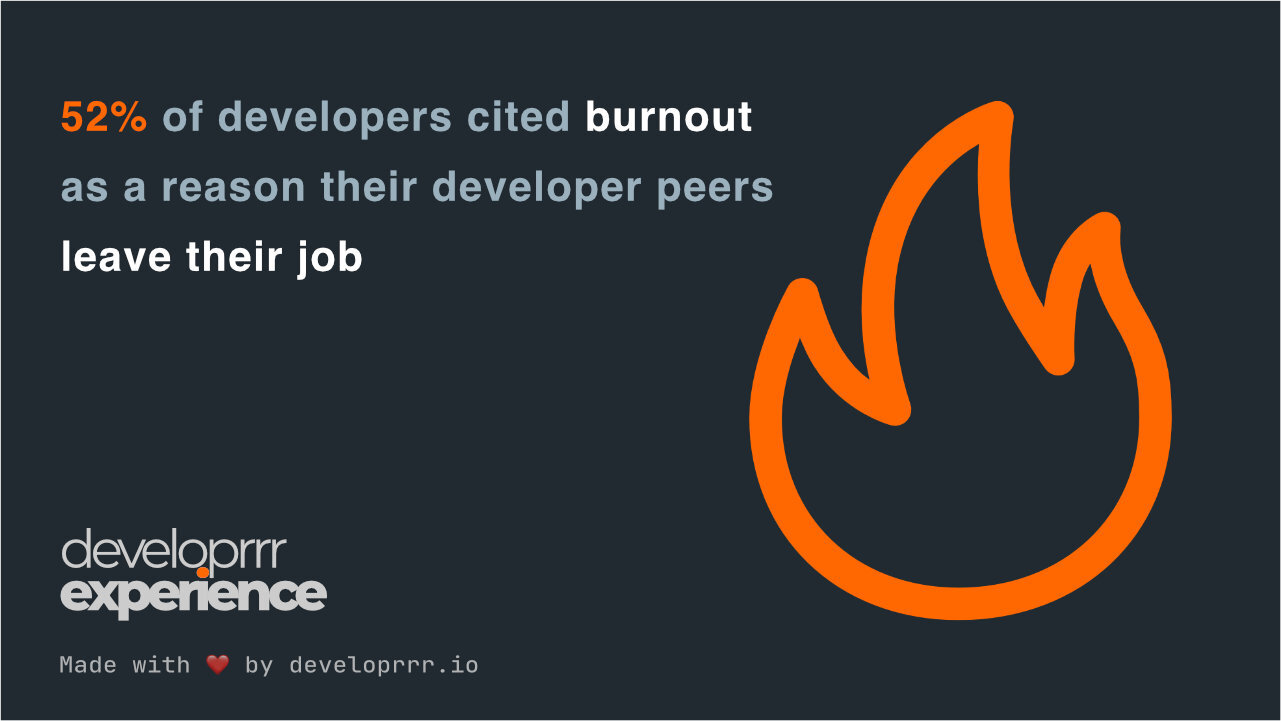
Developer burnout can occur when developers are consistently overworked, under constant pressure, and facing an onslaught of tight deadlines. Not only can this lead to a lack of productivity, but burnout can also lead to physical and mental consequences. For these reasons, it’s not unlikely for organizations to experience high turnover from overworked developers.
📌 Essential Reads
🛠️ Evolution of Platform Engineering and DevEx. An article discusses how platform engineering is transforming developer experience by dismantling complex environments, allowing developers to concentrate on writing high-quality code and contributing to strategic objectives. This approach not only boosts productivity but also enhances developer satisfaction and engagement.
🌐 Enhancing Developer Experience in Edge Computing. Red Hat has improved the edge developer experience by streamlining processes and tools, enabling developers to deploy applications more efficiently in edge environments. This advancement addresses the growing demand for edge computing solutions and aims to simplify development workflows.
🧑💻 Addressing Developer Burnout Through Improved Experience. An article emphasizes the importance of enhancing developer experience to prevent burnout and improve product quality. It suggests that better tools and processes can lead to more satisfied and productive developers.
🛠️ Tools
-
Fx is a powerful JSON viewer and interactive command-line tool for quick JSON data exploration.
-
Refined GitHub is a browser extension that improves the GitHub UI with numerous features like collapsible PRs and improved navigation.
-
GraphQL Voyager is a visualization tool that renders interactive, navigable representations of GraphQL APIs.
Get the next issue on Thursday
5-minute weekly reads showing how top engineering teams solve their biggest DevEx challenges and reduce burnout.
Subscribe for freeDelivered every Thursday. Trusted by 3,000+ engineers at companies like Stripe, Google, and Netflix.