

Issue #14
CI/CD: Why You're Doing It Wrong 🎭
Stop calling it CI/CD when your "pipeline" is just Jenkins running tests before your monthly deployment window. Let's talk about why this half-measure approach is costing you more than you think.

Welcome back, developrrrs! 👋 Stop calling it CI/CD when your “pipeline” is just Jenkins running tests before your monthly deployment window. Let’s talk about why this half-measure approach is costing you more than you think.
🤿 Deep Dive
I’ve got a confession: I cringe every time I hear someone say, “We have CI/CD,” and then, in the next breath, mention their monthly release schedule. That’s like saying you’re a marathon runner because you own running shoes.
According to the State of Developer Experience 2024 report, 60% of organizations are still releasing code on a monthly or quarterly basis, despite having “CI/CD” pipelines in place. Let’s talk about why this half-measure approach is hurting your team more than you realize.
🎁 The Benefits You’re Missing
Feedback Loop on Steroids
With true continuous deployment, your code goes from commit to production in minutes, not months. This instant feedback transforms how you develop. Instead of wondering if your code will work in production, you know immediately. Found a bug? Fix it, commit it, and see it working in production before lunch. Performance issue? Deploy the fix and watch your metrics recover in real time.
But it’s not just about speed - it’s about confidence. When you can see your changes live within minutes, you start writing code differently. You become more experimental and more innovative. Because when the cost of deploying a fix is nearly zero, the fear of making mistakes disappears.
Liberation from Manual Overhead
Let’s get specific about what we’re eliminating: those two-hour deployment planning meetings, the 50-item pre-deployment checklists, the endless back-and-forth emails about deployment timing, and the “who’s available this weekend for the release” conversations.
This isn’t just about saving time - it’s about maintaining momentum. Every manual gate in your process is a momentum killer. Your developers are in the flow, crushing bugs and shipping features, and then everything grinds to a halt, waiting for the next deployment window. That’s not just inefficient - it’s demotivating.
Quality Through Quantity
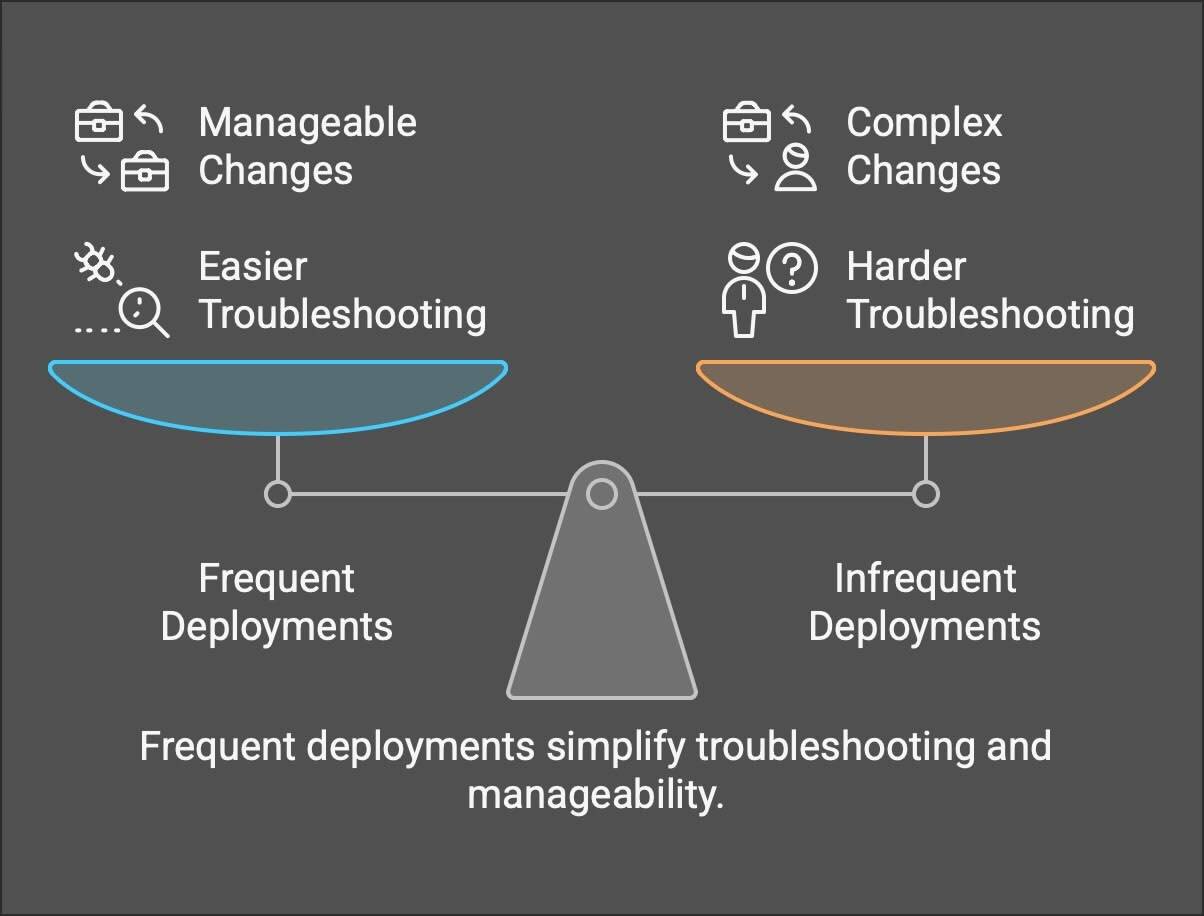
Here’s where it gets counterintuitive: more deployments actually mean fewer problems. When you’re deploying 20-30 times a day, each deployment contains a handful of small, well-understood changes. When something goes wrong, you know exactly where to look.
Compare this to your monthly release: hundreds of changes, multiple features, dozens of developers involved. When something breaks (and it will), good luck figuring out which change caused it. I’ve seen teams spend days debugging issues that would have been obvious if they were deploying continuously.
The Confidence Game
When your team knows their code will be automatically tested and deployed, they write better code from the start. They build testing into their development process because they know there’s no safety net of manual QA later. They think about monitoring and observability upfront because they know they’ll need to verify their changes in production.
😰 Addressing The Fear Factor
“But We Need Rigorous Testing!”
Absolutely - but let’s talk about what that really means. You need:
-
Unit tests that run in milliseconds and catch basic logic errors
-
Integration tests that verify system interactions
-
End-to-end tests that validate critical user journeys
-
Chaos engineering practices that verify system resilience
-
Performance tests that catch regressions before users do
But here’s the key: these tests should be part of your pipeline, not a separate phase that happens before deployment. Each commit triggers the full suite. If the tests pass, the code deploys. If they fail, nothing moves. No human intervention should be required.
“We Need to Monitor Everything!”
Yes, and continuous deployment makes this easier, not harder. Here’s your monitoring checklist:
-
Application metrics: response times, error rates, business metrics
-
System metrics: CPU, memory, disk usage, network traffic
-
User experience metrics: page load times, conversion rates
-
Business metrics: revenue, user signups, core KPIs
-
Anomaly detection: automatic alerting when metrics deviate from normal
The secret is automation. Your monitoring should automatically detect issues and either alert humans or trigger automated rollbacks. No one should be staring at dashboards, waiting for problems.
“Our Culture Isn’t Ready!”
This is the big one. Here’s your roadmap:
-
Start with a low-risk service - something internal, non-critical
-
Build out your testing and monitoring infrastructure
-
Run parallel deployments - automatic deployments alongside your regular process
-
Collect and share metrics showing improved stability and velocity
-
Use this success to drive adoption in other teams
The key is to make it optional at first. Let teams opt-in when they’re ready. Success is contagious - when one team is shipping faster with fewer issues, others will want to follow.
💡 The Bottom Line
Your manual deployment gates aren’t making your system safer; they’re introducing risk. They’re not improving quality; they’re making issues harder to find and fix. And they’re definitely not helping your developer experience; they’re actively hurting it.
It’s time to commit to true continuous deployment. Because if you’re not automatically deploying to production, you’re just automating the easy parts and leaving the hard parts manual.
Stay truly continuous! 🚀
Powered by coffee ☕️ and the absence of change control meetings
📊 Stat
High-Quality Documentation Amplifies Technical Impact by 12.8x

Good documentation is not just supportive but transformational. The 2023 DevOps Report shows that high-quality documentation boosts the impact of trunk-based development on organizational performance by nearly 13 times.
💡 Key Insight: Investing in documentation is foundational to leveraging technical capabilities effectively.
📌 Essential Reads
🤖 AI’s Growing Impact on Developer Experience. A survey conducted by GitHub indicates that 92% of U.S.-based developers are already utilizing AI coding tools both in and outside of work. Despite this high adoption rate, developers still face challenges such as waiting on builds and tests, which remain time-consuming aspects of their workflow. The integration of AI tools is seen as a step towards alleviating some of these inefficiencies, aiming to improve overall developer productivity and experience.
🛠️ Microsoft’s Expansion of Xbox Research to Enhance Developer Tools. Microsoft is broadening its Xbox Research team to gather feedback from game developers, aiming to understand the tools, support, and challenges faced when developing for the Xbox platform. This initiative seeks to engage with studios not currently releasing games on Xbox to learn from their experiences with competitors’ products. By directly involving developers, Microsoft hopes to address issues and improve the overall development experience on the Xbox platform.
📊 Developer Productivity in 2025. More AI, but Mixed Results. An article from The New Stack discusses the state of developer experience in 2024, highlighting a disconnect between leadership expectations and developers’ actual needs. Developers have consistently identified technical debt and inadequate documentation as primary obstacles to productivity. The piece emphasizes the importance of addressing these issues to improve the overall developer experience.
🛠️ Tools
-
Fleek is a decentralized hosting platform for web applications built on IPFS and Filecoin.
-
SvelteKit is a framework for building fast, modern web applications with minimal boilerplate, optimized for developer productivity.
-
Sonic is a fast, lightweight search backend for building instant search experiences at scale.
Get the next issue on Thursday
5-minute weekly reads showing how top engineering teams solve their biggest DevEx challenges and reduce burnout.
Subscribe for freeDelivered every Thursday. Trusted by 3,000+ engineers at companies like Stripe, Google, and Netflix.